 Imagine what it must be like living with someone who is a dedicated insect photographer. You'll be sitting, chatting in the garden but the photographer's eyes will be constantly drawn away to potential photographic subjects. My wife has to put up with this, but knowing my interest (obsession!), she will often alert me to interesting insects. After opening her garden coldframe yesterday morning at 7.30 am, she announced, "There's a creature that might interest you here".
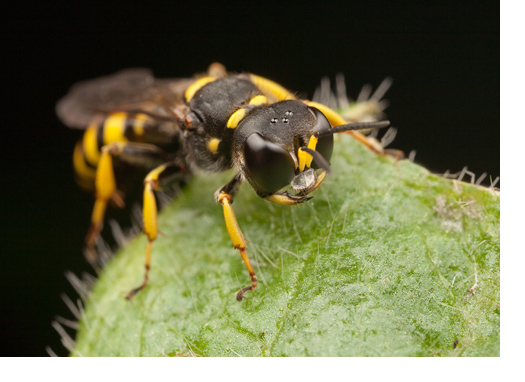
What she had spotted was this Ectemnius Digger Wasp, which had spent the night on a potted plant leaf. Being a cool morning, the wasp was inactive and offered excellent opportunity for photography. The previous day, I had spent a considerable time attempting (unsuccessfully), to photograph very active and "flighty" solitary wasps. This one allowed a dozen or so shots before slowly awakening and finally flying off.
What is immediately apparent about this wasp is its very large eyes and jaws. Good eyesight is essential for this wasp's hunting strategy; catching flies, including hoverflies, on the wing. Captured prey are subdued with a sting and then used to provision the wasp's nests. Nest tunnels are excavated (using those powerful jaws), in fairly large pieces of dead wood such as stumps, fallen tree trunks, rotting logs and occasionally building timbers. The developing larvae feed on the flies.
There are around ten species of Ectemnius wasps in the UK and getting a reliable species identification from photographs can be difficult. After reviewing lots of online resources though, I'm thinking with its size (around 12mm), silvery hairs on the clypeus (lower face), solid yellow bar on the rear thorax and entire yellow bands on the abdomen; it might be Ectemnius cephalotes. Whatever, this is a fine-looking wasp and was a great photographic subject.


Click on any of the three images above for a larger version.