 Determined to provide more opportunities for bee photography in the garden, in 2011 I set about designing a "bee hotel". I looked at lots of commercially-available and home-made examples, but nothing quite provided what I was after.
I knew that the Red Mason Bee, Osmia bicornis (=Osmia rufa) was one of the species most easily attracted to bee boxes and there's lots of literature from the US, where fruit growers like to attract Mason Bees to their orchards to assist pollenation. Many use specially-manufactured cardboard "bee tubes" with rolled paper liners. I had been given some of these as a present but wanted to include other "habitats" too.
It became clear from my research that holes of 7-8mm diameter were favoured by Red Mason Bees but to ensure suitable habitats for other solitary hymenoptera that may use the "hotel" (Leaf-cutter Bees, White-faced Bees etc, and some solitary wasps), holes from between 2mm to 10mm diameter should be provided and should be 5-6 inches (13-15cm) deep.
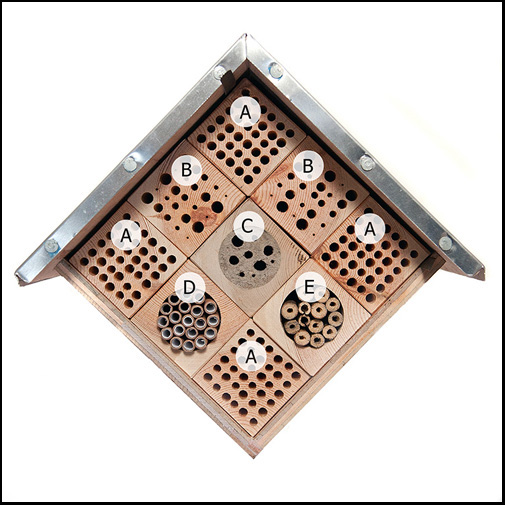
This is the design I came up with. Basically, it's a box with an aluminium-covered roof and nine wooden blocks each 3" x 3" x6" (approx. 8cm x 8cm x 15cm).
Block A: Mixture - 7mm & 8mm holes
Block B: Mixture - 2mm to 10mm holes
Block C: Soft mortar with 2mm to 10mm holes
Block D: 2" hole with paper "bee tubes"
Block E: 2" hole with bamboo stems.
I plan to see (and record) what my "local" solitary bees prefer and by using varying hole sizes and "habitats", how many different varieties I can attract. I'll be posting reports from time-to-time during the year, but there has been no activity to date.
The box is (as recommended), on a south-facing wall and gets the sun for most of the day.